
Sales Outsourcing in France: What Works, What Doesn't, and What to Expect
May 15, 2026

TL;DR. Sales outsourcing in France works when the partner targets directors only, runs discovery-led calls in French, and operates on local mobile data. It fails when a company treats France like the US or the UK and translates the same playbook. This post shows what 12 months of in-house France hiring actually costs, what working France outbound looks like by the numbers, and the method that took Fibbl from zero meetings to 52 in six months.
It's month nine in France and the pipeline is wrong.
Your French SDR is competent. The list is fine. The CRM is clean. The meetings that do happen sit on managers who keep saying they need to "consult" someone before the next call. Your forecast slips again. You can't fire the SDR because of the notice period. You can't escalate because the deal never reached director level in the first place.
This is the most common story we see when a B2B software company expands into France with the same motion that worked at home. The execution is fine. The motion itself is wrong.
Sales outsourcing in France requires a different altitude, a different call style, a different data stack, and a different cost structure than the rest of Europe. Translation alone doesn't get you there. If you get those four things right, France becomes one of the strongest markets in your portfolio. If you get them wrong, you spend hundreds of thousands over twelve months learning what we're about to lay out.
Why the standard playbook dies in France
France is more hierarchical than the UK, the US, or even Germany. Decisions live at the top. Directors run the budget, the agenda, and the vendor selection. Managers don't.
This breaks three assumptions that most expansion plans carry over from the home market.
The first assumption is title parity. In the US and the UK, every B2B software company is full of VPs. In France, "VP" is a rare title outside multinationals. Most senior commercial and technical leaders carry the "Directeur" title and report directly to a member of the executive committee. A pipeline full of "Sales Manager" or "Marketing Manager" replies in France is a pipeline of people who can't sign anything.
The second assumption is speed of trust. US buyers move fast and reward bold first-call asks. French buyers move slower and reward demonstrated relevance. They will take a meeting only if the call earns one. They will book a second meeting only if the first one moves their thinking. Even when conversations happen in English, things get lost between English and French expectations. The product is rarely the blocker. The motion runs at the wrong altitude, in the wrong tone, from the wrong source of trust.
The third assumption is that France is one market. Paris-headquartered enterprises behave differently from regional mid-market companies. CAC40 buyers tolerate longer sales cycles than family-owned ETIs. Foreign companies that paint France as a single block miss this every time.
POV alert: this is the part where most agencies say "we cover France." Covering France is not the same as selling in France. The two are usually run by completely different people with completely different training.
What 12 months of in-house sales costs in France
Fully loaded, one productive French SDR or senior salesperson costs between €110,000 and €160,000 per year. That is the comparison number. The €70,000 or €80,000 on-target earnings on the offer letter is the smallest line in the budget. Founders who anchor on it are comparing the wrong figure to the outsourced quote.
A productive senior SDR in France earns between €45,000 and €65,000 base, plus a variable of €15,000 to €25,000. On paper that is a €70,000 commitment. In practice you pay more.
French employer social charges add roughly another 40 to 45 percent on top of base. According to INSEE, French hourly labour costs rose 2.4% year-on-year in Q3 2025, driven by a sharp decline in employer social-security exemptions. Hiring costs in France are getting more expensive, not less.
Then come the tools. ZoomInfo and Apollo do not have the French professional mobile coverage you need. Conversation rates collapse without local data. A working French outbound stack requires a France-native data provider on top of the global one, which adds roughly €500 to €1,500 per month per seat once you include enrichment, dialing, and verification.
Add management overhead. One senior SDR alone is not a function. They need a manager who reviews calls, validates messaging, and runs the weekly diagnostic. If you don't have that internally, the SDR drifts. If you do, the manager is another fully loaded cost.
Then comes the part nobody quotes in month one. Hiring in France is one-way for at least a year. The legal notice period for ending an open-ended contract (CDI) is one month for tenure under two years and two months beyond, with collective agreements often pushing this longer. Add unfair-dismissal exposure, the labour court bias toward the employee, and the union dynamics in larger firms. If the hire doesn't perform, you carry the cost for months before you can act.
A worked example: a senior cybersecurity salesperson, France
Take a senior cybersecurity AE in France on a 50/50 split. The headline number on the offer letter is €80,000.
Line itemAnnual costBase salary€40,000Variable / commissions€40,000Gross on-target earnings€80,000Employer social charges (~42% of gross)€33,600Sales software stack (€1,800/month)€21,600Allocated management overhead (manager + sales ops)€25,000Fully loaded annual cost€160,200
The €80,000 figure is what the salesperson sees. The €160,200 is what the company actually pays for them to be productive in France over twelve months. That ratio of roughly 2x is consistent with what we see across European in-house build-outs: employer social charges alone double the gross, and the rest of the loaded cost comes from the infrastructure required to make the person effective.
That figure also assumes the person stays. If they leave at month ten, you absorb the notice period, a recruitment fee for the replacement (typically 20 to 25 percent of base), and the ramp time before the next hire reaches steady state. Most senior sales tenure in B2B SaaS sits between 18 and 24 months. Plan as if you are paying for three years to keep the seat productive for two.
SDR economics work the same way. The combined annual cost for one productive French SDR in seat, fully loaded, lands in the same €110,000 to €160,000 range. SDR tenure in Europe averages 9 to 12 months. Most companies never reach steady-state output from a single hire before they have to start over.
A 20-hour-per-week outsourced engagement in France costs between €36,000 and €60,000 annually with the data stack, the manager, the SDR, and senior strategic oversight included. The two models carry different financial profiles and different risk. The agency cost is a monthly retainer you can stop. The in-house cost commits you for at least a year before you can act on a bad hire. Our breakdown of sales outsourcing pricing across Europe shows how agency retainers, performance models, and hybrid setups actually price.
If you want to run those numbers against your own pipeline and CAC math, our 7-Figure Go-To-Market Blueprint walks through the comparison line by line. The Blueprint is designed for founders deciding between in-house, outsourced, and hybrid models in a European expansion plan.
The sales outsourcing compliance trap in France
There's a France-specific regulation almost no B2B software company expanding into France knows about until they get a letter from the DGCCRF. It's called Bloctel.
Bloctel is the French government's opt-out registry for commercial calls. Consumers register their numbers, and professionals are legally prohibited from calling them. The fines are not symbolic. According to the French government's official guidance on abusive telephone solicitation, companies face fines of up to €375,000 per breach under Consumer Code Article L242-16. A new law tightens this further from January 2026.
For B2B, the trap is the personal mobile. Many French professional contacts carry one personal mobile and one company mobile. Data providers don't always distinguish. If your outbound dial list contains a personal mobile registered on Bloctel, every call is exposure. A bilingual SDR running an unfiltered list can put your company at six-figure risk inside a quarter without realising it.
This is one of the operational reasons we built a Bloctel screening step into every French B2B cold calling workflow before the SDR makes the first call. Most agencies operating from outside France don't do this. Most internal hires don't even know it exists. The same compliance scrutiny is one of the questions we recommend buyers ask in how to choose a sales outsourcing agency in Europe.
The method that works in France
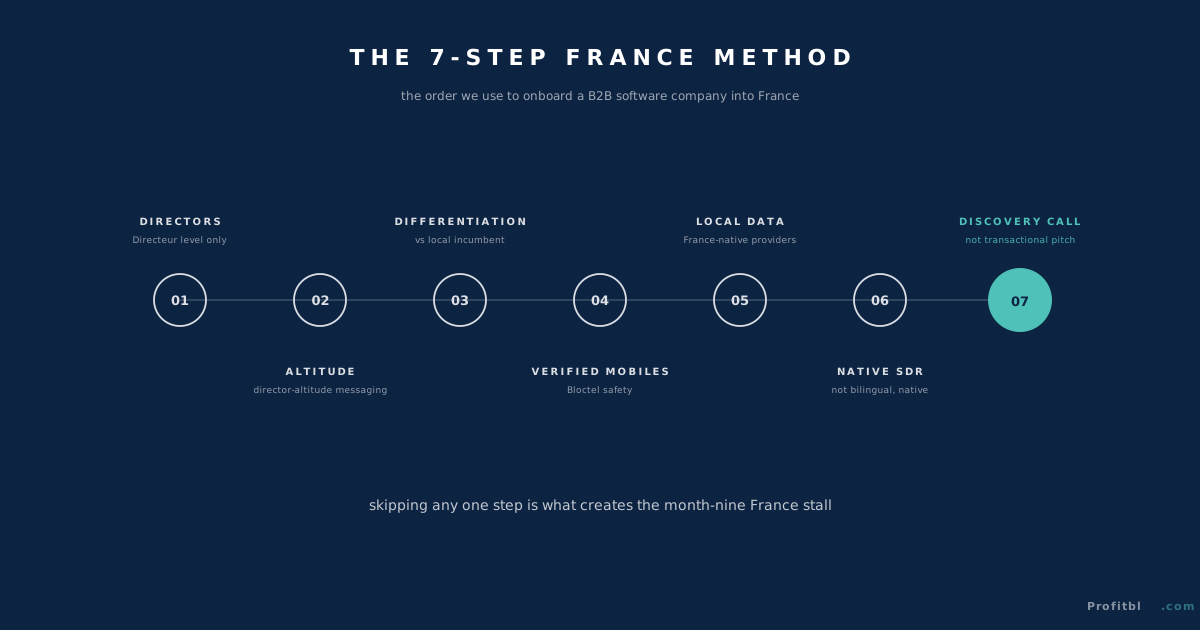
Here is the order we use when we onboard a B2B software company into France today. Every step matters because skipping any one of them is what creates the "month nine" scenario we opened with.
- Identify the directors specifically. Not VPs. Not managers. Build the list at "Directeur" level and Chief-level only. Anything below that is intelligence, not pipeline.
- Build messaging that resonates at director altitude. Director-level cold calls do not work with feature-led pitches. They work with hypotheses about the business: a market shift, a regulatory pressure, a competitor move, a peer outcome. The opener has to land at their height, not your product's height.
- Clarify your differentiation against local incumbents. France has strong local vendors in almost every B2B category. The first question a French director asks is "how are you different from [the French incumbent]?" If you can't answer that in one sentence, the call ends.
- Verify mobile numbers as professional, not personal. Bloctel exposure starts here. Trust also starts here. Calling a director on what turns out to be their kid's school's emergency contact is one of the fastest ways to burn a brand.
- Use local French data providers. ZoomInfo and Apollo are not enough for French mobile coverage. You need a France-native enrichment source, ideally combined with a waterfall pipeline that validates each contact through two providers before the SDR ever dials.
- Put a native French speaker on the calls. Trust builds faster, the register adjusts naturally to the prospect's level, and there is no friction in translation. Bilingual is not the same as native. A native French SDR earns conversational space a bilingual one does not.
- Run discovery-based cold calls, not transactional pitches. France ghosts the pitch. Discovery-led openers, mirrored language, and labelled emotions earn the meeting. The SDR's job on the first call is to make the prospect think, not to sell. Pitches happen in round two.
The step most generic agencies skip is the combination of steps 1 and 7. They translate the script and keep the targeting flat. They run the same persona mix in France as in Germany or the UK. The result is a campaign that books meetings with the wrong people and then loses them at the first internal review.
What working France campaigns look like by the numbers
Working France campaigns produce zero qualified meetings in months one and two while the targeting, messaging, and call style calibrate. They ramp into double digits by months four and five, and settle into a steady-state of 8 to 15 qualified meetings per month after that. Here is the curve from Fibbl, one of our SaaS clients entering Europe.
Fibbl, a Swedish company selling 3D and augmented-reality software for fashion e-commerce, came to us to enter the French market in the SMB and Enterprise segment. Their standard outreach had worked everywhere else in Europe. In France, the first month produced zero qualified meetings. The second month produced zero qualified meetings.
Most agencies would have told them the market was wrong.
Fibbl made a different call. They committed to rebuilding the entry from the ground up. The targeting moved from marketing-manager level to Head of Marketing and Chief Digital Transformation Officer. The first month of conversations surfaced specific French-language objections, and Fibbl rebuilt their counter-positions around each one. The opener shifted from pitch-first to discovery-led.
Month three: 6 qualified meetings.
Month four: 9 qualified meetings.
Month five: 25 qualified meetings.
By month six Fibbl had 52 qualified meetings in France and three major client acquisitions, including one large enterprise. One deal closed in under five days, because Fibbl got in front of the right decision-maker ahead of a buying-trigger event in their market.
Once the foundation held, Fibbl hired a French-native sales lead based out of Sweden to take the engagement forward. The sequence, agency first then in-house second, is the model that works for a new market. The agency builds the entry. The in-house hire scales once the motion is proven.
The pattern repeats across our other case studies in France. A CRM SaaS for the legal sector booked 21 qualified meetings and €70,000 in pipeline in month one with a 20%+ connect rate. A French construction-tech vendor selling into Vinci, Eiffage, and SNCF booked 62 qualified meetings in three months, with 42 of them landing in month three alone after the targeting was refined.
The in-house failure mode shows up just as clearly. A US developer-tools company selling into 1,000+ employee French enterprises came to us nine months into their direct hire. Their French SDR team kept going on extended sick leave under French labour rules. They were never at full capacity. They were behind forecast. They could not fire and rebuild without paying out months of notice. Switching to an outsourced SDR engagement was how they transferred the labour risk back to a vendor whose business depends on filling the seat every day.
The single first step before you do anything else
If you take one thing from this post and act on it today, do this.
Pick one country and run a 30-day pilot before you hire.
Not a six-month engagement. Not a full SDR contract. Not a Country Manager hire. Run a 30-day micro-campaign on one segment, one persona, one problem in France. Measure connect rate, conversation-to-meeting rate, and quality of the meetings. Let the data tell you whether the playbook needs rebuilding before you commit hundreds of thousands to a hire you cannot easily unwind.
This is what the 7-Figure Go-To-Market Blueprint is built to support. The framework walks through how to scope the pilot, what benchmarks to hit, and how to decide whether to scale, pivot, or stop.
Frequently Asked Questions
Is sales outsourcing legal in France?
Yes. There is no legal restriction on outsourcing sales activity to a French or European agency. The compliance constraints sit on the activity itself, not on whether it's run by an employee or an agency. The most important rule for B2B outbound is the Bloctel registry, which applies regardless of who places the call. A reputable French sales outsourcing partner runs Bloctel checks on every dial list as a standard operating procedure.
How much does it cost to hire a French SDR vs outsource?
A fully loaded French SDR (base salary, variable, social charges, tools, management overhead, and tenure replacement cost) sits between €110,000 and €160,000 per year. An equivalent outsourced engagement of 20 hours per week sits between €36,000 and €60,000 annually with the data stack, the manager, and senior strategy included. The bigger difference is risk transfer. The agency cost is a monthly retainer you can stop. The in-house cost carries a legal notice period under French CDI rules and ongoing exposure to labour court risk.
Do I need a native French speaker for outbound in France?
For B2B targeting French directors at French companies, yes. Bilingual is not enough. A native French SDR earns conversational space, adjusts register to the prospect, and removes the translation friction that French buyers use as a filter for whether to take a call seriously. The exception is multinationals where the buyer routinely operates in English. Even there, the meeting itself usually happens in French.
Is Bloctel a problem for B2B cold calls?
It can be. Bloctel applies to consumer numbers, but many French professionals use one mobile for personal and business contacts. A French data provider that incorrectly classifies a personal mobile as a professional one creates direct exposure. Fines reach €375,000 per breach for companies under Consumer Code Article L242-16. The fix is to screen every French dial list against Bloctel before the SDR makes the first call.
How long does it take to see results in France?
Honest expectations: month one and sometimes month two produce zero qualified meetings while the campaign is calibrating. Months three to six are when output stabilises if the targeting, messaging, and call style are right. The Fibbl curve of 0, 0, 6, 9, 25, 12 over six months is a realistic shape for a working France campaign. If you're still at zero in month four, the motion is wrong, not the market.
Should I hire in-house or outsource for France?
Most B2B software companies entering France for the first time benefit from outsourcing the entry, then hiring in-house once the motion is proven. The agency carries the labour risk during the calibration phase. The in-house hire takes over once the playbook is documented and the early customer base is real. Skipping the calibration phase by hiring first is what creates the "month nine, no pipeline" scenario.
What size of company benefits most from outsourcing in France?
B2B software companies doing €1M or more in ARR, with deal sizes of €10,000 or more, and a defined ICP. Below those thresholds, the unit economics of agency-driven outbound rarely work. Above them, the math compounds quickly because the agency cost is fixed and the deal value scales.
What to do next
If you want to see how sales outsourcing in France could apply to your pipeline, book a 30-minute call. We'll walk through your France expansion plan, where the current motion is likely to break, and what a working 30-day pilot would look like.
For the broader question of how to evaluate an outsourced partner, our pillar guide to the best sales outsourcing companies in Europe walks through the criteria that separate good agencies from bad ones.
For the full framework on entering France or any new European market, the 7-Figure Go-To-Market Blueprint covers the pilot structure, the cost comparison model, and the decision framework for in-house, outsourced, and hybrid setups.
Turn Your Random Efforts Into a Predictable Revenue Machine Without Hiring a Single New Rep


Take action today
So schedule your 30-minute introductory call today.
Stop riding the revenue rollercoaster and start confidently forecasting your growth
Unlock a systematic outbound channel that delivers consistent results month after month.

