
Sales as a Service for B2B Software Companies: What It Is and How It Works
May 16, 2026

You've signed a sales-as-a-service contract and you're three months in. The invoices are predictable. The meetings are not. Your account manager is professional, the reports look like reports, and there's a Slack channel where someone says "great progress" every Friday.
You still can't tell what's actually being built underneath. You can't tell if you'd be set up to run this yourself in six months. You can't tell if anything is compounding.
That gap between "subscription paid" and "system owned" is what most B2B software companies get wrong when they buy sales as a service. Most agencies are designed to keep you in it. The good news is the difference between an agency that compounds and an agency that doesn't isn't subtle once you know what to look for.
This post defines the term using the way buyers actually describe it, separates a real service from a vending machine, walks through how the engagement is structured at Profitbl, and gives you the question that flushes black-box vendors out of any evaluation.
What "sales as a service" actually means
Sales as a service is a subscription to a compounding go-to-market system you eventually own. The opposite of that is a black-box vendor relationship where meetings appear, money goes out, and the IP stays with the agency. The phrase covers both, and the two products produce very different outcomes 12 months in.
The phrase gets used loosely. When we run discovery calls, prospects describe what they want using their own language. Two phrases come up constantly: "end-to-end sales service" and "full sales cycle outsourcing." A founder I spoke with last month described what he was looking for as "an outsourced commercial function that runs alongside us, not in place of us." Another one called it "a SaaS-style subscription for the part of the business I don't want to build yet."
Those descriptions are closer to the truth than most agency websites. A real sales-as-a-service engagement looks more like a SaaS subscription than a project. You pay monthly. You get a working system. The system gets better over time because the team behind it is iterating on your account, not just executing on it. And when you eventually take it in-house or restructure, you walk away with documented assets, not just a payment history.
That's the standard. Most agencies don't meet it. The ones that don't are running on a vendor model dressed up in service-model language.
Why B2B software companies buy sales as a service in the first place
Three reasons keep showing up across the discovery calls we run.
Your account executives don't have time to prospect. According to Salesforce's State of Sales research, sales reps spend roughly 70% of their time on non-selling work. Hunting decks, updating CRM, chasing approvals, handling existing accounts. The selling time that remains gets eaten by demos and closing motions on deals already in flight. Cold outbound is the activity that loses every internal scheduling fight. Sales as a service exists because someone has to do the prospecting, and the people you've hired for it aren't doing it.
Building the function internally is slow and expensive. The Bridge Group's 2024 SDR research puts the average SDR ramp time at 3.2 months, a number that has barely moved since 2007. Add two months to find and onboard the hire, three to four months for them to become productive, and you're looking at five to seven months before your first internal SDR is contributing real pipeline. A serious agency can run its first calls inside two weeks. The speed gap is real.
You don't yet know what your sales motion is. Most B2B software companies under €5M ARR don't have a sales playbook. They have a founder who closed the first ten deals through relationships and a handful of inbound leads. The outbound motion, the message that converts to a meeting, the objection map, the calling cadence, the persona that actually buys: none of it has been written down. A real sales-as-a-service engagement is the cheapest way to build all of that and own it. A bad one will run for nine months and leave you exactly where you started.
McKinsey's B2B Pulse 2024 makes the same point in different language. Across 100+ B2B companies, the ones growing efficiently are the ones that have invested in repeatable commercial systems rather than headcount. The subscription model gives a software company access to a repeatable commercial system before they're big enough to build one themselves.
How a sales-as-a-service engagement is actually structured
There's a commercial model, a team model, a cadence, and a deliverables list. Together they form what you're paying for monthly.
The commercial model
Retainer plus commission. The retainer pays for the system: the senior SDR, the Sales Director time, the data operations, the tooling, the management overhead. Commission aligns the team to quality outcomes: closed deals, ideally, not booked meetings.
Pure retainer is what black-box agencies sell. The agency gets paid regardless of result, which removes the incentive to push hard once the contract is signed. Pure commission goes the other way. Agencies on commission-only pricing optimise for the cheapest, fastest meeting that meets a thin qualification filter. The calendar fills with tire-kickers because the agency only gets paid if a meeting lands, so any meeting that lands is the right meeting. Both models break in opposite directions.
Retainer plus commission, weighted toward the retainer, with the commission tied to revenue rather than meeting count, is the only structure I've found that produces a long-term partnership that doesn't reward either party for cutting corners. Agency pricing across Europe sits at €6,000 to €12,000 per month per senior SDR for serious operators.
The team behind the seat
A senior SDR is the front of the engagement. Behind them sits a Sales Director, a GTM engineer who handles data operations, list building, and enrichment, and the agency's own operations layer. The AE function stays with the client. We hand off qualified meetings; the client closes.
That last point matters. A common failure mode is the agency that promises full-cycle closing. The closing motion belongs to whoever owns the product roadmap and the customer relationship. That's the client. The boundary is what protects the engagement from drifting into something it can't deliver.
The cadence
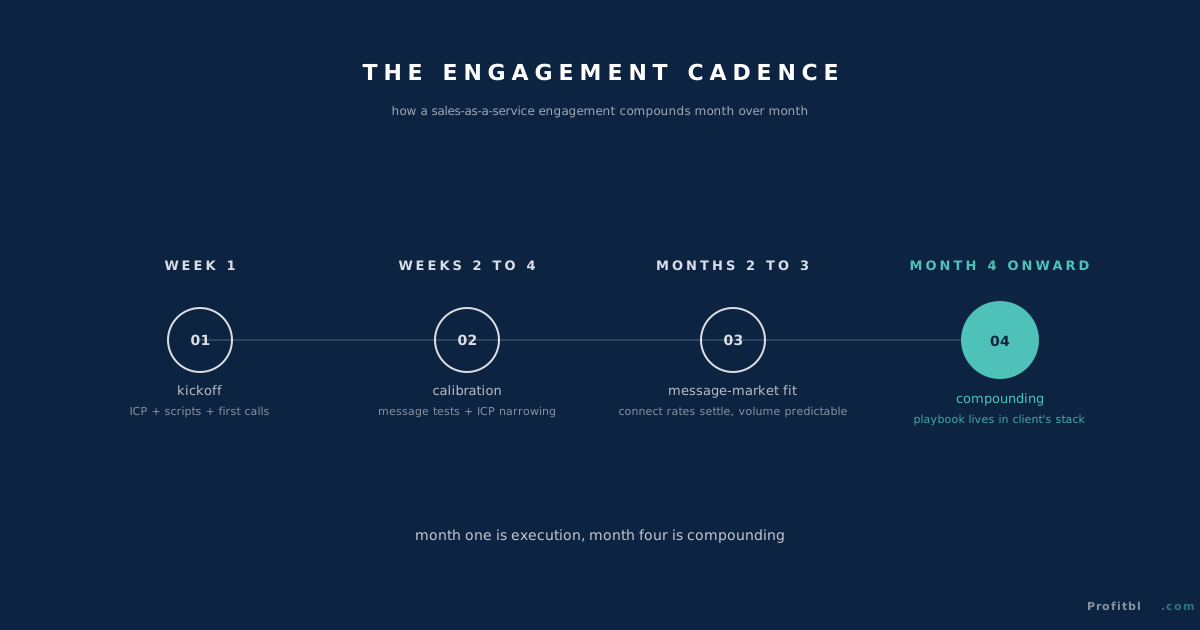
Most engagements follow the same arc.
Week one is kickoff. ICP definition, scripts, tech stack setup, list building, calendar links, Slack channel. By the end of week one we're running calls.
Weeks two to four are calibration. The team is on the phones every day. The Sales Director and the SDR are reviewing what's working in real time. Subject lines get rewritten. Objections get logged. The ICP starts to narrow from "B2B software companies in Europe" to "B2B software companies, 50 to 250 employees, expanding from UK to DACH, with a head of sales who's been in seat under 18 months."
Months two and three are when message-market fit starts to stabilise. Connect rates settle. Meeting volume becomes predictable. The objection bank is documented enough that a new SDR could pick up the engagement and run it within a week.
Month four onward is compounding. Weekly reviews continue. QBRs run quarterly. The playbook keeps getting updated. The client starts using language from the SDR's calls in their own marketing materials.
What the buyer pays for monthly
Twenty hours per week of senior SDR call activity. The Sales Director's strategic time. The GTM engineer's list and enrichment work. The full tooling stack (CRM, dialler, enrichment, email infrastructure, conversation intelligence). And, just as importantly, the artefacts the engagement produces: the ICP document, the message-market fit memo, the objection playbook, the buying-language file, the market intel from every conversation.
If you can't see those artefacts in your shared drive at month six, you're paying for meetings and a black box.
Where it fails: three patterns of buying it wrong
Watching B2B software companies churn through agencies, three failure patterns repeat. Each one starts with the wrong mental model.
Pattern one: the vending-machine buyer
The buyer treats sales as a service like a vending machine. They pay, they expect meetings, they evaluate on meeting count, they don't integrate the agency into their go-to-market, they don't share market feedback, and they don't read the call notes. Three months in, results are below expectation and the buyer churns. They sign a new agency. The pattern repeats.
We onboarded a B2B SaaS founder last year who came to us after running eight outbound agencies in two months. He had a clean view of which agencies had "underperformed" and a tight set of criteria for the next one. He had no view of the fact that not one of those engagements had been run as a service. They'd been run as a vending machine, and the machine had failed eight times in a row.
That conversation became a discovery question we now ask every prospect with a multi-agency history: "Before we talk about us, can you tell me what was happening at each of those eight agencies, on your side, when the work stopped producing?" Sometimes the answer is illuminating. Sometimes it's a list of complaints with no introspection. The latter is a kill criterion for us now. We won't be the ninth.
Pattern two: the cost-of-sales spreadsheet trap
The buyer builds a vendor comparison spreadsheet. The headline metric is "cost of sales as a percentage of expected quarterly revenue." Every agency gets plotted against the threshold. The frame feels rigorous.
The frame is the trap. Most B2B software companies don't compute the right ACV for the math. They use gross revenue per deal, which includes pass-through licensing or hardware costs that flow straight to a third party. The number that matters is margin ACV, which is what the company actually keeps after cost of goods. A €30K headline ACV often hides a €12K margin ACV. The math changes by a factor of two-and-a-half.
I had a discovery call with a prospect who had Profitbl modelled at 22 to 23% cost of sales against a 10% threshold. He was rejecting every agency in his sample. When we walked through the ACV definition together, his real margin ACV moved the math meaningfully closer to his threshold. The vendors hadn't changed. His frame had.
A real sales-as-a-service engagement will sit down with you and help you compute that number honestly. A black-box vendor will tell you what they cost and let your spreadsheet do the rest of the work.
Pattern three: the pay-per-lead chase
The buyer wants risk-shifting. They've been burned by retainer agencies that took money for nine months and produced nothing. The next agency they sign with offers pay-per-meeting. The buyer feels protected.
The buyer is not protected. They've signed up for a calendar full of meetings that pass a thin qualification filter and convert at 2%, because the agency only gets paid when a meeting lands. Every account that takes real research, real ABM work, real persistence, is now unprofitable for the agency to chase. So they don't. The buyer ends up paying €500 per meeting for meetings that produce no pipeline, and the in-house AE quietly stops accepting them.
A different pricing model won't fix this. You solve it by treating sales as a service the way you'd treat any other subscription you depend on: with the expectation that the work compounds, that the agency owes you a system at the end, and that risk-shifting through commission alone is a signal you don't trust the relationship.
What doing it right looks like
A B2B fintech in Belgium signed with us in early 2025. Eighteen employees, €800K ARR, selling AML and compliance software to mid-market financial institutions. They'd tried a network-based founder-led motion for two years and hit a ceiling. They couldn't get into the right rooms at the right banks.
We ran the engagement as a service from week one. The kickoff produced a documented ICP, a refreshed pitch, a calling cadence tuned to their persona (compliance officers and heads of risk at mid-tier banks), and three message tests we ran in parallel. By month two we had a working sequence. By month four they were getting consistent qualified meetings. By month seven they'd signed their first new logo from the program. By month ten they'd closed €1.8M in new ACV, cut their average sales cycle by 67%, and signed a multi-year renewal with us at expanded scope.
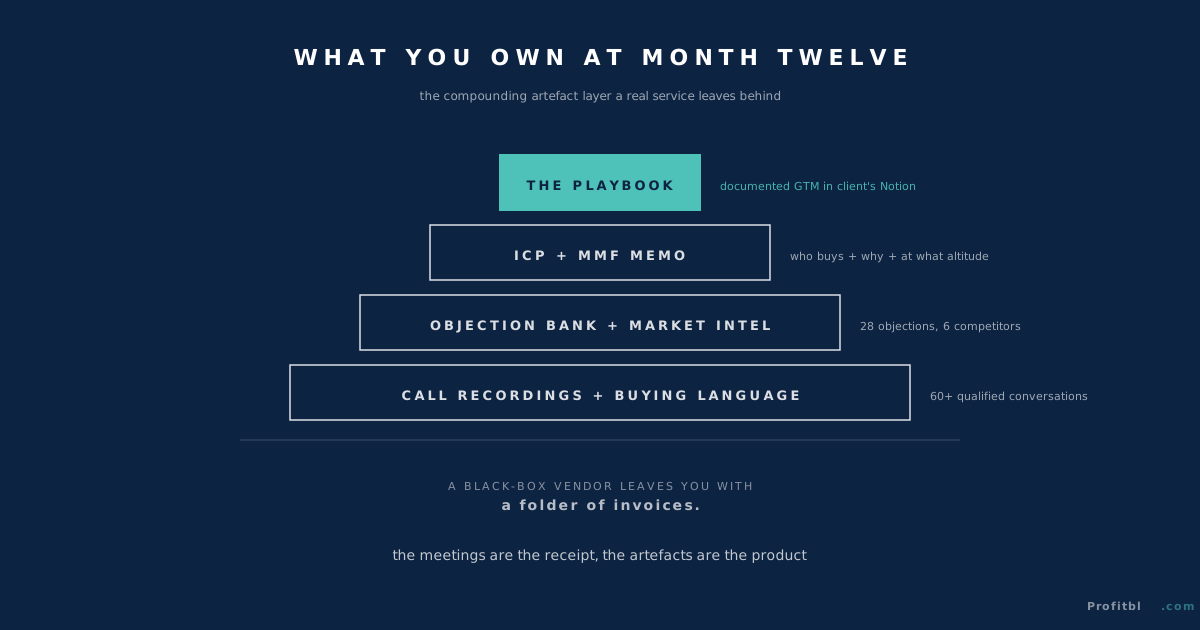
The €1.8M is the receipt. The substance of the engagement was what they owned at month twelve: a documented playbook on their own Notion. They had an objection bank with 28 entries and a verified response for each. They had recordings of 60+ qualified calls in their conversation-intelligence platform, indexed by stage and outcome. They had a market intel doc with positioning notes on six competitors based on what prospects had said about each.
If the engagement had ended at month twelve, they could have hired one internal SDR and run the system themselves with about a 20% productivity haircut. That's what a service is supposed to leave behind. A vendor relationship leaves you with a folder of invoices.
The commercial model is one half of why a result like that happens. The other half is how the buyer shows up. The clients who get the most out of sales as a service treat the engagement as a two-way enablement partnership. They forward us market intel from their customer calls. They invite us into their internal sales meetings. They tell us when a competitor's pricing changes. They share their roadmap. They read the call notes.
A founder I work with put it cleanly on a recent QBR: "We're here to like clients, lookalike clients. We're here to enable you as well. So ask us questions so that we can remove blockers for you." He was framing his side of the relationship as enablement, not delivery. That posture is what separates a productive partnership from a quarterly performance complaint.
The same posture works in the other direction. We push back on clients when their ICP is too broad, when their pitch isn't differentiated, when their AE follow-up is killing conversion, when their pricing is wrong for the market they're chasing. None of that is in the contract. It's what makes the service worth subscribing to instead of just buying meetings on the open market.
There is a second dimension to "doing it right" worth naming. Sales as a service does not have to be the entire sales motion. The most durable engagements are usually one half of a two-sided structure: in-house for the home market, agency for new geographies.
Build an in-house SDR layer where institutional knowledge compounds. Your home market is where your founders speak the language, know the buyers, and can coach a junior hire through every gap. Patience is justified there. The eighteen-month bet on building in-house is the right bet when the market is captured and the geography is yours.
Then use sales as a service for the markets where speed matters more than depth. France next quarter. DACH after that. The Nordics later. Each new market is six to twelve months of agency engagement that captures the local objection bank, the messaging tests, the connect-rate baseline, and the ICP refinement before you hire your first in-house SDR in that geography. The agency does the discovery work. The captured signal makes the in-house hire ramp in six weeks instead of five months.
We've also seen clients structure the engagement as an explicit ownership transfer. The agency runs the market for twelve months. The playbook lives in the client's Notion or CRM, not ours. At month thirteen the client hires their first in-house SDR with a fully documented messaging stack, an objection library, a connect-rate baseline, and recorded calls in the buyer's language. The handover is the product. The meetings booked along the way are the receipt.
A third pattern is surge capacity. A stable in-house team running the home market, plus agency surge during a product launch, expansion phase, or pipeline gap. The agency is variable cost. The in-house team is fixed cost. The mix protects the P&L during volatility. One UK client of ours runs a five-person home-market in-house team and turns the agency layer on and off across their product launches.
How to evaluate sales as a service before you sign
Three checks to apply before you put a vendor on a six-month contract: the math, the fit, the vendor.
Run the math first
Three situations where the math doesn't work, and sales as a service isn't for you yet.
Your ACV is below €5K and your sales cycle is under 60 days. A senior SDR's monthly cost requires deals large enough to justify the time investment per meeting. Below €5K ACV, you need a self-serve or PLG motion, not a phone-driven service. The pricing structure on senior outsourced sales doesn't bend below that line.
You haven't validated the product. If your conversion from meeting to closed-won is under 5% and you don't yet know why, you don't need more meetings. You need a founder-led sales motion to learn what you're really selling, who's really buying, and what they're really paying for. Sales as a service amplifies a working motion. It can't replace one that hasn't been built yet.
You can't commit nine months. A real engagement compounds in months four through twelve. If your runway or your patience can't carry the program past month three, you'll churn the agency right at the point the curve starts to bend. Better to wait until you can commit, or run a one-week pilot and use it to scope a longer program with clear-eyed expectations.
If the math does work, sales as a service can solve specific pipeline problems with surgical precision. A client in industrial energy software signed with us during a transitional period. Their internal sales team had two of three reps leaving within six weeks, and they needed pipeline cover for the gap. We ran a defined six-month bridge engagement aimed at one specific segment they couldn't crack from inside. By month six their first enterprise meeting from the program converted to a closed €240K deal. The CFO described the contribution in their next board meeting as "closing the gaps with that money." That was the right product for the right problem at the right time.
Stress-test the vendor
Three questions, applied early in the evaluation, will tell you which side of the service-vs-black-box line a vendor sits on.
"What artefacts will I own at month six?" A real service will name them specifically: ICP document, message-market fit memo, objection playbook, call recordings, conversation summaries. A black box will answer in process language ("we report weekly," "we run QBRs") without naming any artefact you can take with you.
"Walk me through what you'd change in our engagement at month three if pipeline volume was on target but conversion to opportunity was 50% below." A real service will describe a specific diagnostic: targeting review first, then messaging, then AE follow-up. A black box will tell you they'll "iterate" or "optimise."
"How do you bring my AE team and your SDR onto the same call review cadence?" A real service has a documented process. A black box will improvise the answer.
Then decide
Sales as a service is one option in a wider decision. The full landscape includes hiring in-house, hiring a fractional VP Sales, running pay-per-lead through a marketing agency, or doing nothing and waiting for inbound to scale. If you want the rest of the map: our pillar guide to the best sales outsourcing companies in Europe covers the agency landscape, we've written separately on what an outsourced sales agency actually does and what it doesn't, on how agencies price their services, on how to evaluate one against another, and on SaaS sales outsourcing in Europe for what to expect at each ARR stage.
If you're ready to evaluate sales as a service for your own business this week, three actions will get you to a clear answer:
If you want a structured walkthrough of those steps, the SDR Services Selection Framework takes about 20 minutes and ends with a usable decision document. If you'd rather have a 30-minute call to test whether sales as a service fits your business specifically, book a growth session and we'll run the math together.
The black-box era of outsourced sales is ending. The companies subscribing to a real service are building the GTM systems their competitors will need to copy in three years. Pick the side of that line you want to be on.
How to Avoid Wasting €150K+ on the Wrong Sales Outsourcing Vendor (and Find Partners Who Actually Deliver ROI)


Take action today
So schedule your 30-minute introductory call today.
Stop riding the revenue rollercoaster and start confidently forecasting your growth
Unlock a systematic outbound channel that delivers consistent results month after month.

