
What Does an Outsourced Sales Agency Actually Do? (And What It Doesn't)
May 16, 2026

TL;DR. What an outsourced sales agency actually does is run a relentless diagnostic loop: outbound, measure every conversation with a decision-maker, identify patterns by ICP slice and vertical, then iterate messaging week by week. The meetings are the output. The system is the deliverable. This post breaks down the work behind the meetings, the four things an agency cannot fix, and the single question to ask before you sign with anyone.
It's month four and you're about to cancel.
The meetings happened. The reports landed in your inbox every Friday. Your team got busy. You replied to half the Slack threads from the agency before you had time to think about them. Then you opened the pipeline report and saw the same number you had at month one. The agency says they need more time. Your CFO says they have given them enough. You're 50,000 EUR in and you don't know what you'd document if someone asked you what you learned.
So what is outsourced sales actually doing for that money? And why does the same agency, on the same script, produce 850,000 EUR of pipeline for one client and nothing for another?
The honest answer is that almost no SERP result tells you. Every glossary page and landing page defines outsourced sales as "a third-party firm that handles top-of-funnel activity on your behalf." Technically correct, operationally useless. The real work, the team behind it, and the boundary of what it cannot do is the part nobody publishes. Here it is.
Vendor agencies vs system agencies, the only distinction that matters
There are two kinds of outsourced sales agency, and they look identical until month four. A vendor agency rents meetings: a calendar log, an invoice trail, and nothing the client owns when the contract ends. A system agency builds a playbook the client owns: documented ICP refinements, a messaging library, the dial cadence that converts, the objection answers that move buyers, the segmentation rules. Same meetings on the surface. Different deliverable underneath.
Most B2B software buyers compare agencies on price, geography, and SDR seniority. Those are floor checks. The line that decides whether your 50,000 EUR compounds or evaporates is which kind of agency you signed with.
At month six with a vendor agency, you have a calendar log and an invoice trail. The institutional knowledge of what worked in your market walks out with them when the engagement ends.
At month six with a system agency, you have the same meetings and a documented playbook. At month twelve, you can hire an in-house SDR and they ramp in weeks instead of months, because the work is written down.
The same outsourced sales agency, with the same SDR, delivers wildly different results across clients for exactly this reason. The clients who get a system make the learnings permanent. The clients who get a vendor restart from scratch every time something changes.
What an outsourced sales agency actually does, day by day
An outsourced sales agency runs four parallel workstreams every week: a four-role team executing outbound, a documented weekly rhythm of build-launch-diagnose-review-revise, an intense qualitative and quantitative review process the client never sees, and a constant stress-test of the client's message-market fit. The meetings are the output. The work behind them is the deliverable.
The team is not one SDR
A working outsourced sales function is at least four roles, not one. Most agency pitches highlight the SDR's CV. That's the wrong fixation. The SDR is one input in a system.
- The SDR. The voice on the phone, the person in the inbox. Senior agency SDRs run 40 to 80 calls a day, average 6 to 12 conversations with decision-makers, and surface the qualitative signal the rest of the team needs to iterate.
- The Sales Director. The diagnostic layer. Reviews recorded conversations, identifies which objections recur, which ICP slices respond, which verticals don't convert, and what to change next week. This is the role most agency buyers don't even know exists.
- The Growth Marketer / GTM Engineer. Owns the data stack, the enrichment waterfall, the sequence tooling, the dashboards. Makes sure the SDR is calling the right person, with a working number, on a clean cadence. Most internal SDR teams don't have this person. The work falls on the SDR and absorbs 25 percent of their selling time.
- The Account Strategist or shadow AE. Sits with the client on the handoff, hears how the meetings convert, reports back what the buyer actually objected to in round two, feeds it back into the SDR's pitch. The agency that doesn't have this role is flying blind on what happens after the meeting is booked.

For context: according to the Salesforce State of Sales report, B2B sales reps spend only 28 percent of their time actually selling. The other 72 percent goes to CRM updates, internal meetings, and research. That 72 percent is exactly what the Sales Director, Growth Marketer, and Account Strategist absorb so the SDR can stay on the phone. A solo internal SDR carries all of it themselves.
The weekly rhythm nobody shows you
Working agencies run a rhythm. Not a schedule on a slide, an actual weekly cycle:
- Thursday. List build for the following Monday. The Growth Marketer runs the enrichment, the Sales Director signs off on the targeting, the SDR previews the priority accounts.
- Monday. Launch. The new sequence opens. Calls start.
- Wednesday. Mid-week diagnostic. Sales Director reviews 5 to 8 recorded conversations, flags one or two messaging shifts, sends them to the SDR for the back half of the week.
- Friday. Weekly review with the client. What worked, what didn't, the patterns we're seeing by ICP slice, the proposed message change for next week. Decisions, not status.
- Monday again. Revisions baked in. Loop runs.
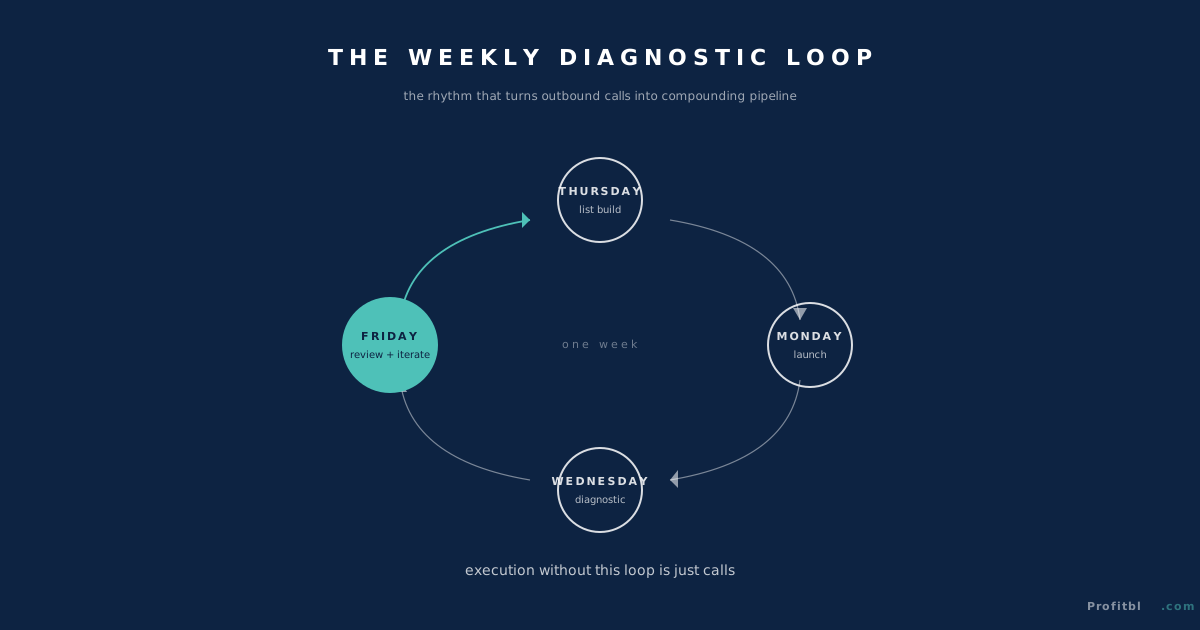
The rhythm is the system. The week-over-week iteration is the difference between an engagement that compounds and one that flatlines. Most agency buyers don't see the rhythm because it happens before Friday's report.
The intensity of review is what nobody talks about
The diagnostic loop is what clients most consistently underestimate. Outbound is the input. Measuring every conversation with a decision-maker is the work. Reviewing the qualitative and quantitative side of the data, looking for patterns within ICP and within verticals, extracting what works and what doesn't: that's where the meetings actually come from. It's not just making calls and having conversations. It's the week-to-week iteration of messaging based on what the data tells us.
Most clients don't see the intensity of review and understanding that goes on behind the scenes. Two clients with the same agency get wildly different results for exactly that reason. Real conversations feed the loop. If the messaging or the ICP is wrong, the loop surfaces the gap inside the first month. The agency that runs the loop, documents the findings, and adjusts produces meetings. The agency that doesn't produces a calendar log.
Most generic agencies skip the loop entirely. They run the playbook the SDR brought with them and report the number of dials at the end of the week. That's the vendor model. It's also why so many engagements break at month four.
The first job is message-market fit, not meetings
Here's the part that takes years of running campaigns to admit out loud.
The agency's first job is stress-testing, and often rebuilding, message-market fit for the client on the client's behalf. Booking meetings is the output that follows. Without message-market fit, no amount of execution produces results. The same agency, with the same SDR, the same data stack, and the same weekly rhythm, will deliver 850,000 EUR of pipeline in three months for one client and zero meetings for another. The variable is whether the client's message lands with the buyer the client says is their ICP.
A working engagement reveals this in week one. The first set of conversations either confirms the messaging or surfaces the gap. If the gap exists, the agency worth hiring stops running the original sequence and starts rebuilding. The vendor agency keeps dialing because dialing is what's on the contract.
The most common founder complaint about outsourced sales agencies sits on top of this exact dynamic. Clients hire us to do lead gen. They actually hire us to do market research. They arrive with unclear ICPs, vague positioning, and five niches they want to test simultaneously. Then they blame the agency at month four for not closing deals from any of them.
A system agency picks one niche, runs the loop, surfaces what works, documents the playbook for that niche, and only then expands. A vendor agency dials all five.
What an outsourced sales agency cannot do
There are four things an outsourced sales agency cannot fix, no matter how good the team or the rhythm: a broken ICP, a stalled handoff, missing product-market fit, and leadership that measures dials. Each one is a self-test the buyer can run today, and each one is the reason a strong agency fails for the wrong client.
It cannot fix a broken ICP the founder never tested with prospects. Right now, count how many real conversations you've held with people you believe are your buyer in the last 60 days. Under 20 means your ICP isn't validated. The agency can run the conversations on your behalf and discover the ICP in real time. But it cannot invent it before the calls start.
It cannot close deals after the handoff. This is the most expensive failure mode. We've seen clients book 62 BANT-qualified meetings over six months, with decision-makers, confirmed need, and confirmed budget, and close zero of them. The ceiling wasn't the outbound. It was the handoff. Right now, check your last ten first-meetings booked. How many had a second meeting scheduled within seven days? Fewer than five means the handoff is your cliff. If your sales team ghosts qualified meetings, slows the follow-up, or pitches feature-first when the prospect needs outcomes, the agency cannot save you there.
It cannot rescue a product without buyers. Some companies hire an outsourced sales agency to confirm they have product-market fit. They don't. PMF is not a lead-gen problem dressed up as one. Right now, check the last 12 months. Have you closed three or more deals at your target ACV from any cold-sourced channel? If no, the issue is the product, not the prospecting. If the meetings happen and the conversion rate stays at zero, the agency has done its job. The product has not.
It cannot compensate for leadership that measures dials. Working agencies measure pipeline contribution, conversation-to-meeting rate, qualified meeting volume, and revenue attribution. Right now, ask your leadership what they would measure to call the engagement successful. If the answer is dials per day or emails sent per week, you're already set up to fire the agency for hitting the wrong metric. The agency cannot compensate for that mismatch by working harder.
Beyond those four conditions, in-house has structural strengths an outsourced engagement cannot match. Naming them is what separates a real evaluation from an agency pitch.
Product depth that compounds over years. A good in-house SDR who survives past month nine learns the product to a level no agency SDR ever reaches. They sit in the office. They overhear the engineering team. They know what the new release does before the marketing site does. The Profitbl cost analysis acknowledges this directly: a good in-house hire develops a deep understanding of your product, industry, and messaging that, with repetition and specialisation, outperforms external hires.
Real-time absorption of positioning shifts. When founders refine the pitch at a Tuesday strategy meeting, the in-house SDR is in the room. The next call reflects the change. With an agency, that signal travels through a weekly review and a written brief and arrives on the phones four to seven days later.
The path to the AE role. Your best in-house SDR at month eighteen is your best AE candidate at month twenty-four. Agencies do not build that internal career pipeline for you. If the long-term goal is a self-sustaining commercial team, in-house is part of how you get there.
Lower variable cost at scale. At fifteen to twenty SDRs, fully loaded in-house cost per qualified meeting beats agency cost. The break-even point varies by country and deal size, but the direction is real. The country-by-country cost data piece walks through the break-even math for European markets.
When all of those conditions point at in-house and none of the four "cannot do" failures apply, build internally. The agency is not the only valid answer.
If any of the four cannot-do conditions apply to your business right now, signing with an agency makes the problem more expensive, not less. Run our Outbound Readiness Diagnostic before you sign with anyone. It walks through the seven dimensions of readiness that decide whether an agency engagement will compound or evaporate.
What a working engagement actually looks like
Two anonymised engagements show how the diagnostic loop produces results that compound after the contract ends.
A Belgian cybersecurity GRC consulting firm
Fifteen employees, just over 1 million euros in ARR, four years stagnant on outbound before signing with Profitbl. They had tried everything. Internal sales hires that didn't ramp. Pay-per-meeting providers that delivered the wrong meetings. Generalist agencies that translated their service into a feature pitch and got nowhere (the same shape we see across our case studies).
They committed to running the diagnostic loop for three weeks before any volume push. The first wave of conversations surfaced that NIS2 was the buying trigger their generalist outreach had been missing entirely. They rebuilt the messaging around NIS2-driven compliance pressure, repositioned themselves from "GRC consulting" to "the partner who gets you NIS2-ready before the auditor arrives," and concentrated the sequence on a tightly defined list of regulated companies.
Within three months: 850,000 EUR in pipeline, 17 qualified meetings, 300,000 EUR of pipeline from a single seven-day campaign. The founder's exact reaction: "It has been 4 years that our founder had been looking for someone like you."
The 4-year baseline was the message-market fit gap. The 3-month turn was the diagnostic loop closing it.
An industrial-energy software vendor
Built a real product, had a handful of reference customers in their home market, and could not crack the wider European industrial segment. They had been running outreach themselves for over a year. The targeting fell on Energy Managers because the title sounded right. Almost no meetings booked. Long conversations that went nowhere. They came to Profitbl after concluding the problem was either the market or their messaging, and they didn't know which.
The first month of conversations told them. At large enterprises, the Energy Manager title cannot buy. They're one of five or six specialists, technical influencer at best. The loop produced a documented rule: at large enterprises, Energy Manager is intel-only; the Director or Head is the buyer.
The same loop surfaced the cost-saving-beats-regulation opener rule. Even in markets with strong regulatory pressure, "save 20 to 30 percent on energy" lands harder than "comply with the regulation." It produced a mid-market hedge when enterprise cycles ran long: a segment of 200 to 500 employee chemicals and pharma manufacturers with dedicated energy managers and HVAC loads.
The client owns every one of those rules. Documented, replicable, ready to run in the next country they enter. A vendor agency would have produced the meetings without the rules. They would have a calendar log. They would not have a playbook.
This is also what protects against the agency-tenure problem. According to The Bridge Group's SDR Metrics Report, the average SDR ramps for 3.2 months and stays in role for 1.8 years. The math is brutal: build in-house and you spend three months getting an SDR productive, then have roughly 15 to 17 months of peak output before the seat turns over. An agency engagement that documents the playbook removes the dependency on any one SDR. The IP stays with you when the seat changes.
The single question to ask before you sign
If you read this post and act on one thing today, ask the agency you're evaluating exactly this:
"How will you share the GTM intellectual property you develop on our account?"
If the answer is vague, a weekly report, or a generic dashboard, that's a vendor agency. The IP they develop stays with them.
If the answer includes documented playbooks, ICP refinements, messaging libraries, a handover format, and the rhythm by which findings get transferred to your team, that's a system agency. The IP they develop becomes yours.
Either way, start documenting what's working in your current outbound today. Even one paragraph per week. If you're between agencies, between SDR hires, or running outbound yourself, every captured insight is one less thing you have to relearn the next time. When you do sign, the learnings compound from day one instead of restarting.
Frequently Asked Questions
What is outsourced sales, exactly?
Outsourced sales is a service where a third-party agency handles all or part of your top-of-funnel sales activity on your behalf. That includes prospecting, outbound outreach across calls, email, and LinkedIn, qualification of decision-makers, and booking meetings. The best agencies also handle ICP refinement, messaging iteration, and the diagnostic loop that turns those conversations into a documented playbook your team can run. For the SDR-specific layer of this work, see our breakdown of outsourced SDR services for B2B SaaS.
What's the difference between outsourced sales and lead generation?
Lead generation produces a list or a form-fill. Outsourced sales produces a qualified conversation with a decision-maker who has confirmed need and is willing to meet. Lead-gen agencies optimise for volume and rarely talk to anyone. Outsourced sales agencies optimise for conversation quality and meeting conversion, which is what actually moves pipeline.
How much does it cost to outsource sales?
A typical European outsourced sales engagement for B2B software ranges from 3,000 to 12,000 EUR per month, depending on geography, seniority of the SDR, multi-channel scope, and how much GTM advisory is included in the retainer. We break the model down in detail in our guide to sales outsourcing pricing in Europe.
When does outsourced sales actually work?
It works when the buyer has a defined ICP they've tested with at least 20 prospect conversations, a product with confirmed early buyers, a sales team that can close, and leadership willing to measure pipeline contribution over dial volume. Without those four conditions, an agency engagement makes the underlying problem more expensive, not less.
How long does it take to see results from an outsourced sales agency?
Month one and two are calibration. The first conversations surface what's working and what isn't, and the diagnostic loop runs. Working engagements ramp into qualified meetings by month three, with a steady-state cadence emerging by month four or five. If you're still at zero meetings in month four with a working ICP, the agency is not running the diagnostic loop and you should leave.
Can an agency handle the full sales cycle, not just prospecting?
Some can. Full-cycle outsourced sales engagements run from prospecting to closed deal and are usually structured as a hybrid retainer plus commission. Most B2B software companies hire agencies for the prospecting layer only and keep closing in-house. The full-cycle model works best when the deal size is between 10,000 and 50,000 EUR and the sales cycle is under 90 days.
What's the biggest reason outsourced sales engagements fail?
The handoff. We've seen 62-meeting engagements with decision-makers and confirmed need close zero deals because the client's sales team ghosted the meetings, pitched feature-first, or moved too slowly between rounds. The agency cannot fix the handoff, but a system agency will surface the handoff problem in week three or four through the diagnostic loop. The vendor agency will keep booking meetings into the void.
How do I evaluate an outsourced sales agency before signing?
Ask three questions. Ask how they'll share the GTM intellectual property they develop on your account. Ask which role on their team owns the weekly diagnostic. Ask what they will not do for you, and listen for the four boundary items we covered in this post. An agency that can't answer any of these three is a vendor. We expand the evaluation framework in how to choose a sales outsourcing agency in Europe.
Before you sign with any agency, run your numbers in our B2B Outbound Sales ROI Calculator. It tells you the maximum cost per qualified meeting your unit economics can support, the payback period for an engagement, and whether the math works at your current ACV.
If you want a structured way to test whether your business is ready to outsource sales before you sign anything, run the Outbound Readiness Diagnostic as well. It walks through the seven dimensions that decide whether an engagement compounds or evaporates.
If you want to see how a working outsourced sales engagement applies to your pipeline specifically, book a 30-minute call. We'll walk through where the current motion is likely to break and what the first 90 days would document.
For the broader question of how to evaluate an agency, our pillar guide to the best sales outsourcing companies in Europe walks through the criteria that separate good agencies from bad ones. If France is on your expansion list, our deep-dive on sales outsourcing in France shows what the diagnostic loop looks like in a market that runs top-down and rewards director-level outreach.
Discover Why 68% of Companies Waste Their Entire Outsourcing Budget in Just 3 to 6 Months (And How to Join the 32% Who 3X Their Pipeline Instead)


Take action today
So schedule your 30-minute introductory call today.
Stop riding the revenue rollercoaster and start confidently forecasting your growth
Unlock a systematic outbound channel that delivers consistent results month after month.

